
Open : 9:00am to 5:00pm weekdays


Office Address
4025 Pleasantdale Rd, Suite 250 Atlanta, GA 30340

Phone Number
404-298-1314

Not every AC system needs to be replaced for the same reason. Some homes have an old central system limping through its 15th summer. Others have a working unit that's wildly oversized for the house, costing money every month it runs. Below is what we replace most often in metro Atlanta and the signals that tell you it's time.
Most Atlanta homes built before 2010 still run a traditional split-system central AC. These systems typically last 12 to 17 years in this climate, and the harder they work in our humid summers, the faster the compressor wears down. Replace when the system is over 12 years old, your last two summers included multiple repair calls, or your home no longer cools evenly across all rooms.
Mini-splits make sense for additions, finished basements, bonus rooms over garages, and older homes without ductwork. If your current mini-split is more than 10 years old, struggles in the upstairs heat, or you've added square footage the original unit wasn't sized for, a replacement (or a second head added to a multi-zone outdoor unit) usually solves the problem better than continued repairs.
Heat pumps cool and heat in one system, which is why they're increasingly common in Georgia. A heat pump replacement is worth considering when efficiency drops noticeably, when defrost cycles become unreliable in winter, or when the system is 12 or more years old. Modern variable-speed heat pumps can cut summer energy use significantly compared to a 15-year-old single-stage unit.
Zoning lets different parts of your home cool to different temperatures from one central system. If you've been fighting hot rooms upstairs and cold rooms downstairs, or your current zoning dampers are failing, a replacement with proper zoning design (or a multi-zone mini-split) usually fixes what no thermostat setting can.
A smart thermostat by itself isn't a "replacement," but it's almost always part of one. New AC systems perform best when the thermostat can actually communicate with variable-speed equipment. We install ecobee, Nest, and Honeywell models depending on your equipment and preferences.
If your existing unit is below 14 SEER2 (the current federal minimum in the Southeast), you're paying for inefficiency every month. Replacing with a 16 SEER2 or higher unit, especially an ENERGY STAR certified model, often pays back meaningfully through utility savings, and qualifies for rebates and federal tax credits under the Inflation Reduction Act.
We're a local HVAC company built for Atlanta homes, Atlanta heat, and Atlanta utility bills. Replacement is one of the larger investments you'll make in your house, and the install matters more than the brand on the box. A properly sized, properly installed mid-tier unit will outperform a top-of-the-line system that was rushed in. That's the difference we bring to every replacement.
What you get with B. Tucker:

AC replacement is one part of what we do. Below are the rest of our HVAC services across metro Atlanta. Click through to the page that matches what you need.
Furnace or heat pump replacement with same-week scheduling in most cases.
Annual tune-ups that keep your system efficient and your warranty intact.
New furnace, heat pump, or hybrid system installs for new construction and full system swaps.
Diagnostic and repair service for furnaces, heat pumps, and electric heat.
You are here.
Spring tune-ups that catch issues before the first 90-degree week.
Diagnosis and repair when a working system stops working right.
New AC installs for additions, remodels, and homes without existing central cooling.
HVAC service for small offices, retail spaces, and light commercial buildings.
Installation of rooftop units and split systems for light commercial properties.
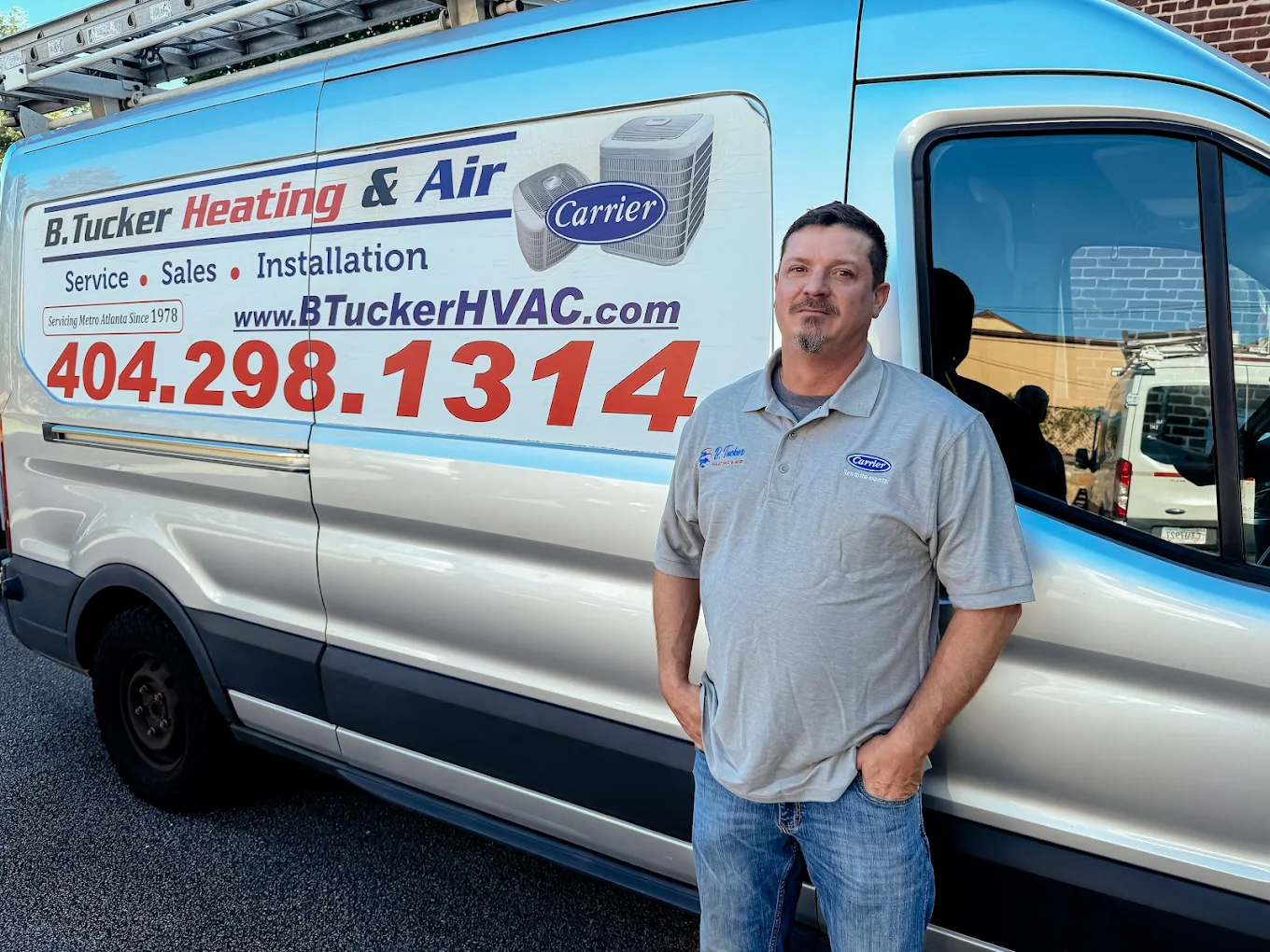
Replacement is a bigger job than a service call, but it doesn't have to take over your week. Here's how a B. Tucker AC replacement actually runs.
A technician comes to your house, measures the space, checks your existing ductwork and electrical, and runs the math on what your home actually needs (not just what's there now). We walk you through 2 or 3 equipment options at different price and efficiency tiers, with the financing and rebate math laid out plainly. You get the written estimate the same day or the next morning.
Once you approve the proposal, most installations happen within the same week. A 2-person install crew handles a typical single-system replacement in one day. Larger or zoned systems may run a day and a half. We pull permits where Atlanta or DeKalb/Cobb/Fulton county requires them, protect your floors, and haul away the old equipment.
Before the crew leaves, the lead installer commissions the system: checks refrigerant charge, static pressure, airflow at each register, and thermostat communication. We walk you through the new thermostat, the maintenance schedule, the warranty paperwork, and what to watch for in the first 30 days. If anything needs adjustment after the first hot week, one call gets a tech back out.

The rule most contractors use is the "5,000 rule": multiply the age of your AC by the estimated repair cost, and if it's over $5,000, replacement is the better investment. Other clear signs are a unit over 12 years old, repeated refrigerant leaks, rising electric bills with no other explanation, and uneven cooling that didn't used to be a problem.
A standard single-system replacement takes one day for most metro Atlanta homes. Two-system homes or replacements that involve ductwork modifications, zoning changes, or new line sets typically run a day and a half. We arrive between 8 and 9 a.m., have the old system out by lunch, and the new system commissioned and running before the end of the day in most cases.
Sizing is based on a Manual J load calculation, not on the size of the unit being replaced. The calculation accounts for your home's square footage, insulation, window orientation, ceiling heights, and number of occupants. Oversizing is the most common AC mistake in Georgia, and it causes short-cycling, poor humidity control, and shorter equipment life. We run a fresh load calc on every replacement.
The federal minimum SEER2 rating in the Southeast region is 14.3 for split systems as of 2023. Most homeowners benefit from going to 15 or 16 SEER2, especially given Atlanta's long cooling season. Variable-speed systems at 18+ SEER2 deliver the biggest comfort improvement and the best humidity control, and they qualify for federal tax credits under the Inflation Reduction Act.
Yes. The City of Atlanta and surrounding counties (Fulton, DeKalb, Cobb, Gwinnett, and others) require a mechanical permit for AC replacement when the work involves refrigerant lines, electrical changes, or equipment over a certain capacity. We pull permits on every job that requires one. Permit fees are typically included in our estimate or itemized separately.
Yes. B. Tucker offers approved financing through partner lenders so you don't have to delay a replacement because of timing. Options typically include 0% promotional periods for qualified buyers and longer-term plans with low fixed payments. We walk through the financing math during the in-home estimate so the monthly number is part of the decision.
B. Tucker provides a 10-year warranty on parts and equipment for systems we install, backed by the manufacturer's warranty (typically Carrier, Trane, or another major brand depending on the system). Labor warranty terms are separate and outlined in your install paperwork. To keep the warranty valid, the system needs annual maintenance, which our maintenance plan covers.
If your current system is past 12 years, struggling through Atlanta summers, or pushing your utility bills higher than they should be, a replacement is worth pricing out. We'll come to your home, measure what you actually need, walk through 2 or 3 options at different efficiency tiers, and put financing and rebate numbers on the table. No pressure, no estimate fee.


