
Open : 9:00am to 5:00pm weekdays


Office Address
4025 Pleasantdale Rd, Suite 250 Atlanta, GA 30340

Phone Number
404-298-1314

A failing AC almost always tells you it's failing before it quits completely. Catching the signal early is the difference between a $200 capacitor and a $2,000 compressor. Here are the seven problems we get called for most often in Atlanta homes, and what's typically behind each one.
If your AC is running but the air coming out of the vents isn't cold, the cause is usually a refrigerant leak, a frozen evaporator coil, or a failing compressor. Don't keep running the system while it blows warm. A unit cycling without proper refrigerant charge can damage the compressor in hours, which turns a repair into a replacement.
Banging, screeching, grinding, and clicking each point to different problems. Banging usually means a loose connecting rod or piston in the compressor. Screeching often signals belt or motor bearing failure. Clicking on startup that doesn't stop is typically a failing capacitor or contactor. Any new noise that wasn't there last week is worth a service call before it gets worse.
Short cycling is when your AC starts up, runs for a few minutes, shuts off, and starts again. It's almost always one of three things: an oversized system (common in older Atlanta homes where someone replaced like-for-like without sizing math), a thermostat reading wrong, or a low refrigerant charge. Short cycling wears equipment out fast and drives bills up.
A thermostat that won't reach the setpoint, won't respond to changes, or shows a blank screen isn't always a thermostat problem. It can be a tripped float switch, a control board fault, or a wiring issue that mimics thermostat failure. A good diagnosis confirms what's actually broken before you replace the thermostat itself.
If your Georgia Power bill jumped without a heat wave to explain it, your AC is probably running longer than it should. Common causes are low refrigerant, a dirty evaporator coil restricting heat transfer, a failing compressor losing efficiency, or a thermostat issue keeping the system running past setpoint. A repair often pays for itself in a single billing cycle.
When some rooms feel cool and others don't, the AC itself may be fine. Weak airflow usually traces back to a clogged air filter, a failing blower motor, blocked or leaking ductwork, or a coil that needs cleaning. Weak airflow upstairs in a two-story Atlanta home is especially common and almost always fixable without replacing the system.
Water around the indoor air handler usually means a clogged condensate drain line, which is the most common AC service call in Atlanta. Humidity here keeps drain pans full year-round, and lines clog with algae and debris. A leak that isn't water (oily residue near the lineset or outdoor unit) is a refrigerant leak, and that needs same-day attention.
Repair calls separate good HVAC companies from bad ones. Anyone can sell you a new system. Diagnosing the real problem, fixing what's broken, and being honest about when a repair stops making sense, that takes a different kind of shop. We've built B. Tucker around that standard.
What you get on a repair call with B. Tucker:
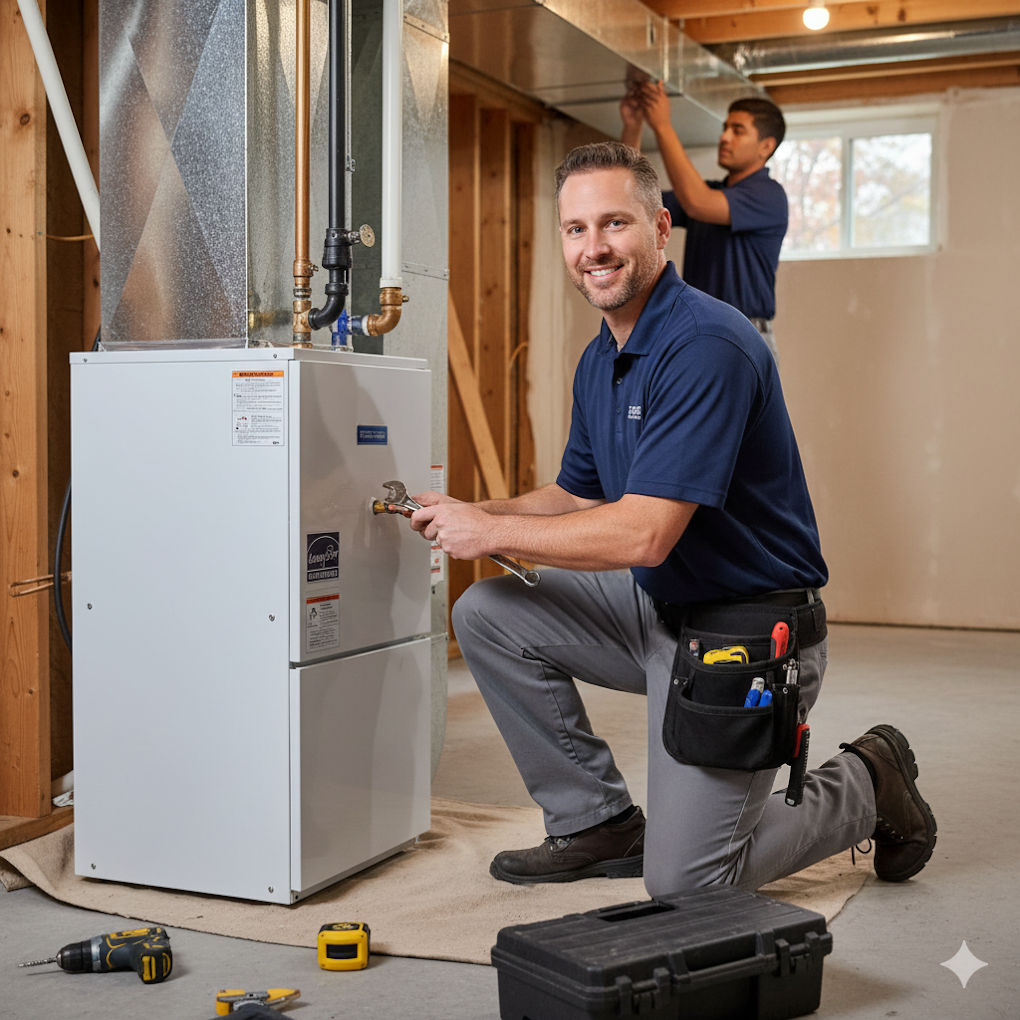
AC repair is one piece of what we do. Below are the rest of our HVAC services across metro Atlanta. Pick the page that matches what you need.
Furnace or heat pump replacement with same-week scheduling in most cases.
Annual tune-ups that keep your system efficient and your warranty intact.
New furnace, heat pump, or hybrid system installs for new construction and full system swaps.
Diagnostic and repair service for furnaces, heat pumps, and electric heat.
Full system swaps with free estimates, financing, and a 10-year warranty.
Spring tune-ups that catch issues before the first 90-degree week.
You are here.
New AC installs for additions, remodels, and homes without existing central cooling.
HVAC service for small offices, retail spaces, and light commercial buildings.
Installation of rooftop units and split systems for light commercial properties.
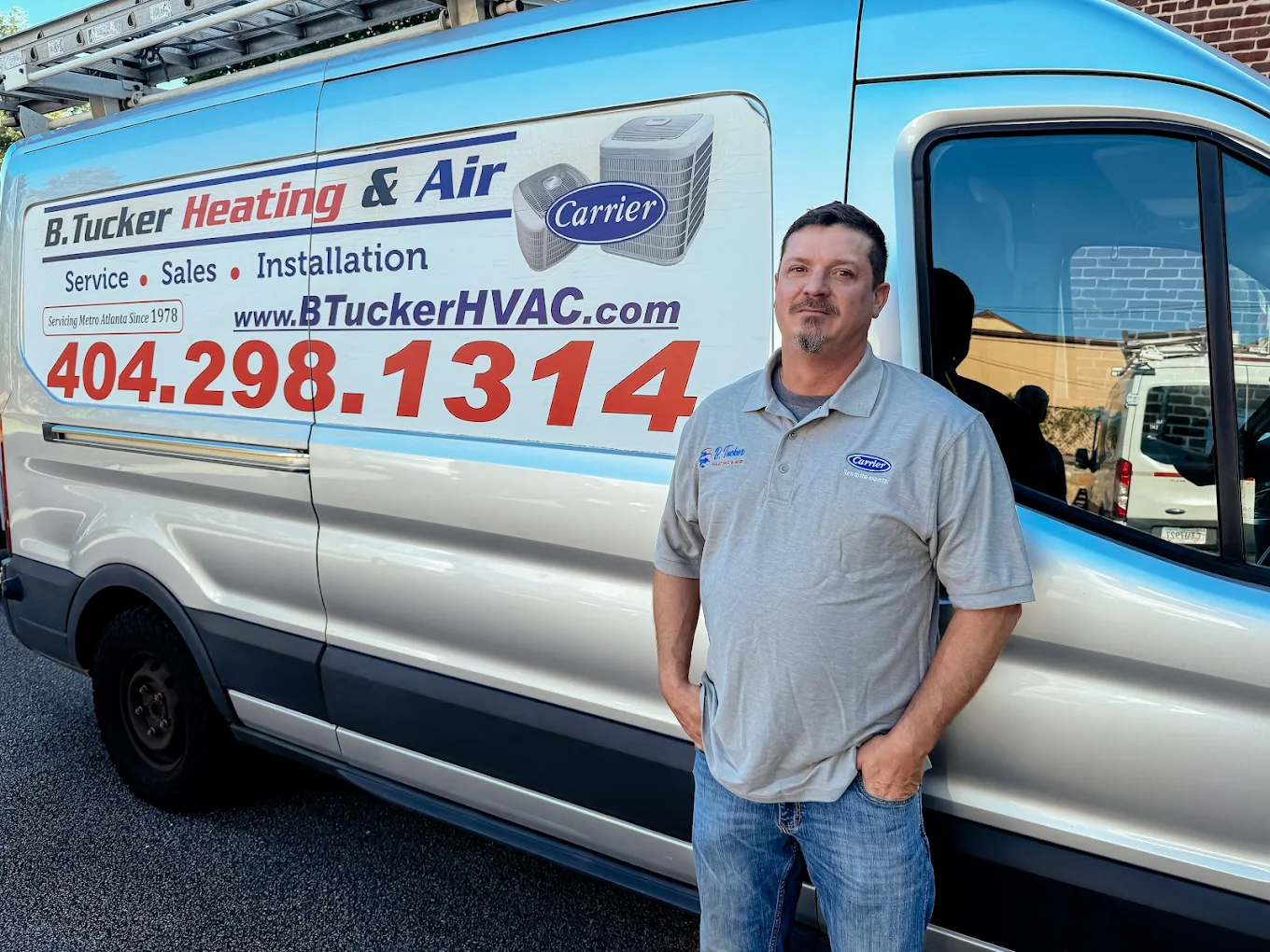
A repair call should be fast, clear, and honest about cost. Here's how a B. Tucker AC repair actually runs.
A technician arrives in the scheduled window, inspects the system top to bottom, checks refrigerant pressures, electrical components, airflow, and the thermostat side of the equation. The point of this step is to find the actual cause of the problem, not just the first symptom. You get a clear explanation of what's wrong and a written quote before any parts come off the truck.
Once you approve the quote, the repair happens the same visit in most cases. Common parts (capacitors, contactors, relays, thermostats, condensate pumps) are stocked on the truck. After the fix, we verify the system is operating correctly: temperature split across the coil, proper refrigerant charge, airflow at the registers, and stable cycling at the thermostat.
Before we leave, we walk you through what we found, what we fixed, and what to watch for. If the repair fixed the immediate problem but the system is showing signs of age, we'll tell you what's likely to come up next, and roughly when. No pressure to replace, just honest information so you can plan.

Same-day or next-day service is standard during cooling season for most metro Atlanta addresses. Calls received before noon are usually handled the same day. During peak heat waves in July and August, scheduling tightens up, so the earlier you call, the better. If your AC is out completely in 90-degree weather, tell the dispatcher and we'll prioritize the call.
Repair cost depends on the part that failed and the labor involved. Simpler repairs like capacitor or contactor replacement are typically the least expensive. Refrigerant recharges, evaporator coil cleanings, and blower motor replacements fall in the middle. Compressor failures are the most expensive and often push the conversation toward replacement. We quote every repair upfront before any work starts.
A useful rule is to multiply the unit's age by the estimated repair cost. If the number exceeds $5,000, replacement is usually the better investment. Other factors matter too: a 14-year-old system needing a $1,500 repair is a different decision than a 6-year-old system needing the same repair. We'll give you a straight answer based on your specific unit and situation.
Most service calls include a diagnostic fee that covers the technician's time to identify the problem. If you approve the repair on the same visit, the diagnostic fee is typically applied toward the repair cost. We confirm the fee structure when you book the call so there are no surprises when the technician arrives.
A frozen evaporator coil is almost always one of three things: low refrigerant from a leak, restricted airflow from a dirty filter or blocked return, or a failing blower motor. Turn the system off and let it thaw before the technician arrives, otherwise we can't accurately diagnose the underlying cause. Running a frozen AC damages the compressor.
A small amount of fan noise is normal, but grinding, screeching, rattling, or a hum that's louder than usual is not. Outdoor units develop noise issues from loose hardware, failing fan motors, debris caught in the fan blade, or compressor problems. Any new or worsening noise is worth a diagnostic call before the underlying issue causes more damage.
Yes. Our technicians are trained on the major residential brands installed across Atlanta, including Carrier, Trane, Lennox, Goodman, Rheem, American Standard, and York, as well as ductless brands like Mitsubishi and Daikin. Brand isn't usually the issue with a repair, the underlying mechanical or electrical failure is what matters, and those are common across manufacturers.
AC not working? Let's get it fixed. If your AC is blowing warm, short cycling, leaking, or making a noise it didn't make last week, the longer it runs that way, the more expensive the repair tends to get. Most AC problems in Atlanta homes are fixable without replacing the system, especially when caught early. Call us, schedule a diagnostic visit, and get a straight answer on what's wrong and what it costs to fix.


